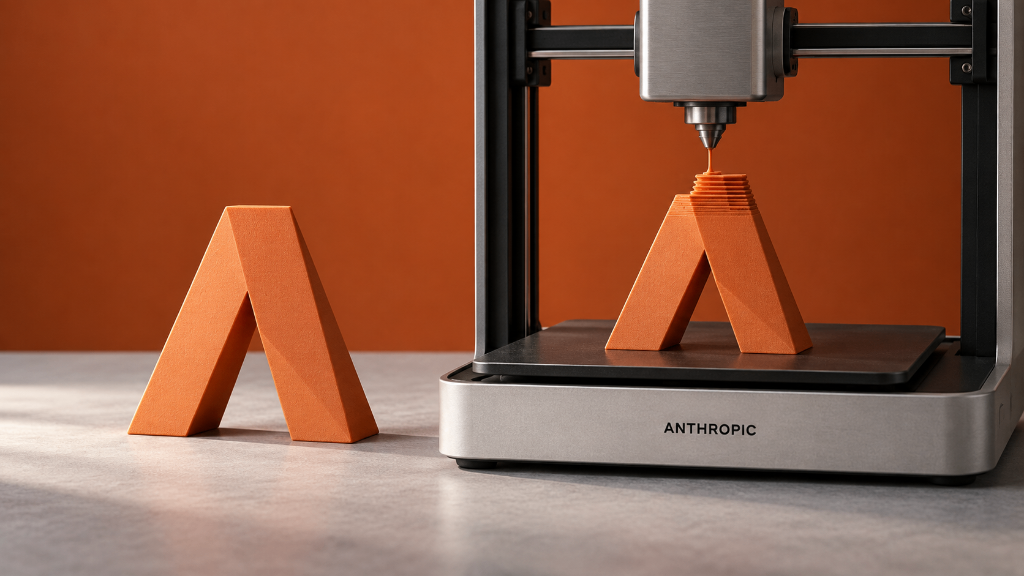
Twenty-six percent is the kind of number that writes its own headline.
On September 17, Anthropic reported that Claude now “leads” 26% of the company’s AI research and development work, up from less than 1% in February. More than 90% of its R&D is performed with Claude at least collaborating. The immediate interpretation was irresistible: the AI is building its own successor.
That interpretation is not entirely wrong. It is also several important steps ahead of the evidence.
Claude is not independently choosing what model Anthropic should build, training it and deploying the result. Anthropic explicitly says none of the measured R&D has reached full autonomy. But the company has documented something that may prove more consequential than another benchmark win: a measurable feedback loop in which today’s model accelerates the work required to create tomorrow’s model.
The 26% deserves attention. To understand why, we first have to understand what Anthropic actually counted.
Read “Leads” as a Technical Term
Anthropic used an automation scale developed by Epoch AI. It runs from AL0, meaning no AI involvement, to AL5, where AI operates autonomously without a human in the loop.
Claude’s 26% figure refers to AL4. At that level, a person provides a high-level task and supervises, while the AI completes most of the work end to end. The human does not need to continuously unblock it, but still reviews the result and controls consequential steps.
Anthropic illustrates the distinction with a broken data pipeline.
At AL3, an engineer brings Claude the logs, discusses the likely cause, lets it investigate and intervenes when something unexpected appears. Claude collaborates, but the engineer remains actively involved.
At AL4, the engineer hands Claude the failure alert. Claude reads the logs, finds the problem, writes and tests a fix, handles surprises, compares the repaired output with the last successful run and documents what changed. The engineer returns at the end and decides whether the fix is deployed.
At AL5, which Anthropic says it has not reached, Claude would detect the failure, scope the work, implement the repair, test it and deploy it without needing a person to initiate or approve the process.
So “Claude leads 26% of AI R&D” does not mean Claude controls 26% of Anthropic. It means that for roughly a quarter of the measured work, the human role has moved from active operator to supervisor.
That is still a significant transition.
The Feedback Loop Is the Story
Most workplace AI stories describe a one-way productivity gain. A lawyer drafts faster. A developer fixes bugs faster. A researcher summarizes papers faster. The same profession produces more output with less time.
AI R&D is different because the output is a more capable AI system.
If Claude accelerates evaluation design, training infrastructure, incident analysis or reinforcement-learning experiments, Anthropic can improve the next Claude more quickly. That newer model may then automate a larger share of the work required for the version after it. Each cycle potentially shortens the next one.
This is why people reach for the phrase recursive self-improvement. But the word “recursive” can hide several very different realities.
One version is dramatic: an autonomous model redesigns itself, trains a successor and repeats the process without meaningful human control. Anthropic’s data does not show this.
The more plausible near-term version is organizational. Thousands of human researchers use tens of thousands of agents to run experiments, repair infrastructure, analyze failures and write evaluation code. Humans still choose the goals and control training, but the laboratory completes more cycles per month. Better models make the organization faster, and the faster organization produces better models.
That loop does not require a conscious AI or a fully autonomous research scientist. It only requires automation to improve faster than new bottlenecks appear.
The important question is therefore not, “Can Claude build Claude alone?” It is, “How much does Claude compress the time between major model generations?” Anthropic has not published that answer.
How Anthropic Manufactured the 26%
The number did not come from counting pull requests or asking employees whether Claude felt useful.
Anthropic sampled 20% of staff in each department involved in model R&D for every week in July 2026. A Claude research agent examined internal work records, including Slack and documentation, and produced a list of roughly 15,000 granular tasks. Claude then organized those tasks into a hierarchy containing 542 nodes and 378 leaf categories, ranging from evaluation-platform debugging to reinforcement-learning sandbox policies and serving incident reviews.
Each category received an automation level. The categories were then weighted using the amount of employee time devoted to them, so a heavily staffed activity counted more than a rare task.
This is much stronger than an anecdote. It is also not an independent measurement.
Claude helped find the tasks. Claude organized them. A Claude judge assessed how automated they were. Anthropic employees checked the classifications, but the company is still using its own model, its own internal records and its own definitions to calculate a number about the success of its own automation.
Anthropic openly acknowledges the problem. Exact model-human agreement was 59%, although model and human assessments landed within one automation level 97% of the time. The company also notes that the border between “collaborates” and “leads” is inherently debatable.
The 26% should therefore be read as a prototype instrument, not a universally comparable industry statistic. If OpenAI or Google published “35%,” the larger number would mean little unless the labs used the same task map, weighting system and independent auditors.
Thirty Thousand Agents Change the Safety Problem
The most striking number in Anthropic’s report may not be 26%.
As of August, approximately 30,000 agents were performing research and engineering work at Anthropic at any one time on its most-used internal platform. Their actions are checked by two monitoring layers.
Online monitors review actions before execution and can block or redirect dangerous behavior. Anthropic says 100% of actions on the measured platform passed through this layer, usually within seconds. Of more than one billion decisions reviewed during August, about 0.002%—roughly one in 47,000—were blocked.
Offline monitors inspect activity after execution, looking for slower and potentially reversible patterns of concern. They flag approximately 100,000 transcripts each week. Classifiers resolve most cases, while roughly 50 high-priority cases per week reach human reviewers.
The tiny block rate can support two opposite stories.
Perhaps the agents almost never attempt dangerous actions, which would be encouraging. Or perhaps the monitor has a narrow definition of danger and misses behaviors it was not designed to recognize. Without independent adversarial testing and a known-positive set of malicious actions, a low block rate does not reveal which story is true.
Scale makes that uncertainty more important. A one-in-47,000 event sounds rare. Across a billion decisions, it becomes tens of thousands of interventions. If future labs operate millions of agents, even a failure rate that looks excellent on a dashboard can produce routine incidents.
This is why Anthropic proposes publishing three monitoring metrics across the industry: coverage, review latency and escalation rate. They are operational measurements, not promises about a model’s personality. That makes them useful—but only when paired with evidence showing what the monitors fail to catch.
The 6% Number Is Harder to Market
Anthropic also measured where its compute went during one week in July.
About 6% of compute used for AI R&D was classified as safety work. Within AI-driven AI R&D, the share was about 12%. Anthropic calls these estimates deliberately conservative: mixed capability-and-safety work was counted as capability work, and separate safeguard-classifier compute was excluded.
The percentages should not be mistaken for a complete safety budget. Interpretability research can require more researcher time than compute, while a single frontier training run can dominate accelerator usage. More efficient safety tools can also reduce the percentage without reducing their value.
Still, the metric introduces an uncomfortable but necessary question. If AI rapidly increases the amount of R&D a lab can perform, does safety capacity scale at the same rate—or does automation mostly accelerate capability work?
Publishing the percentage over time could reveal that imbalance. Publishing it once cannot.
What to Watch Instead of the Next Model Score
Anthropic’s disclosure will matter if it becomes a time series rather than a launch-day statistic.
The first signal is the movement from AL3 to AL4. Collaboration above 90% tells us Claude is nearly ubiquitous inside the research process. The 26% leadership figure tells us where humans can step away until review. If that share rises rapidly, the cadence of AI development may change even before any task reaches full autonomy.
The second signal is the human review burden. Agent count can grow much faster than expert attention. If 30,000 agents become 300,000 while the number of qualified reviewers stays flat, “human in the loop” may remain technically true while becoming operationally weak.
The third signal is independent verification. Anthropic says it plans to embed external evaluators with access comparable to internal risk teams. Those evaluators should be able to inspect the task taxonomy, reproduce automation ratings, test monitor blind spots and report incidents without the lab controlling every conclusion.
The final signal is elapsed time. If increasingly automated R&D does not shorten training, evaluation and release cycles, then some other constraint—compute, data, scientific judgment, hardware or safety review—is absorbing the gains. If the cycles do shorten, the feedback loop is no longer theoretical.
This Is Not Self-Improvement Yet. It Is the Runway Toward It.
Anthropic deserves credit for publishing numbers that complicate its own safety argument. The report shows a company using AI to accelerate model development while simultaneously arguing that society may need to slow the frontier. That tension is not a contradiction to be dismissed; it is the central coordination problem facing AI labs.
No company wants to be the only one that slows down. No regulator can make an informed pacing decision if the relevant acceleration data remains inside the labs. Capability benchmarks reveal what the latest model can do. Anthropic’s proposed measurements attempt to reveal how quickly the next one may arrive and whether oversight is keeping pace.
Claude is not autonomously building its successor. Humans still choose the goals, control the compute, approve consequential actions and decide what ships.
But when a model leads one quarter of the work involved in creating future models, “humans are still in control” is no longer the end of the analysis. We also need to know how many humans, how closely they are watching and how quickly the system moves while they do.
The 26% is not proof of recursive self-improvement.
It may be the first public speedometer for the road leading there.
Sources
- Anthropic: Measurements for understanding the pace of AI development inside frontier labs
- AP: Anthropic says Claude is helping build its next version