The next phase of AI may not be one giant model answering every question. It may be a network of specialized agents: one plans, another searches, another writes code, and another checks the result.
That vision has always had a practical problem: how do independent agents communicate without every company building a custom connector for every other company?
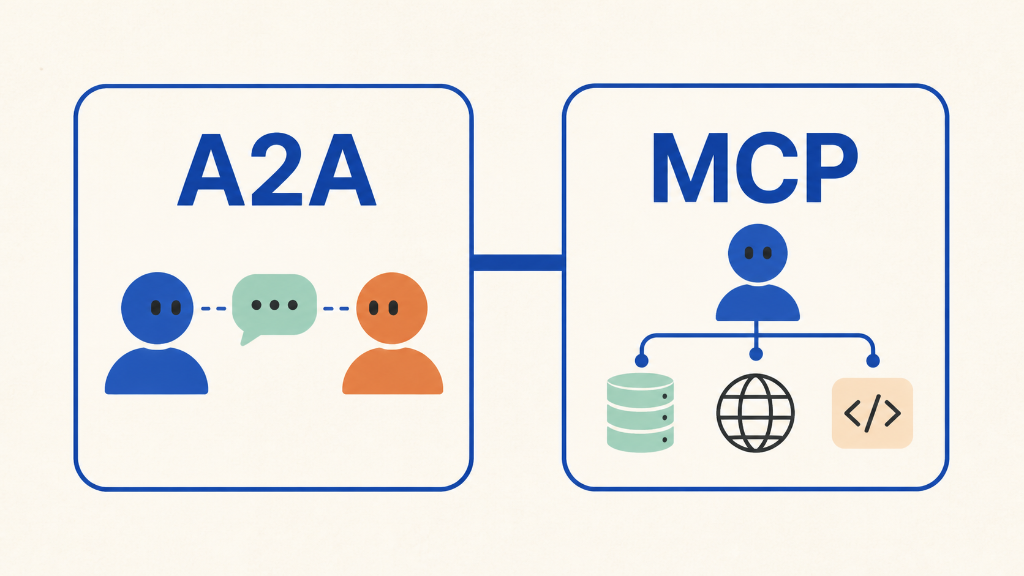
Two open protocols are starting to clarify the answer. The Model Context Protocol (MCP) gives an AI application a standard way to reach tools, data, and external resources. The Agent2Agent (A2A) protocol gives one agent a standard way to discover and work with another agent.
The distinction sounds simple, but it could become the foundation for a much more composable AI software stack.
The news: A2A and MCP are moving closer together
On August 17, Axios reported that A2A, originally created by Google, is moving to the Agentic AI Foundation. That puts A2A in the same open-source foundation ecosystem as MCP, which is backed by Anthropic and has become a common way to connect models to tools and data.
This is important because the two protocols solve different sides of the same integration problem. MCP is about an agent reaching outward. A2A is about agents reaching across to one another.
The move does not mean that every AI product will suddenly become interoperable. Standards still need compatible implementations, reliable identity, sensible security, and enough developer adoption. But shared governance removes one source of friction: vendors can build against public interfaces instead of negotiating a new protocol for every partnership.
MCP versus A2A in one sentence
MCP connects an agent to capabilities. A2A connects an agent to another agent.
MCP can expose a database, browser, filesystem, search service, or internal API to an AI application in a predictable format. The model does not need to know each vendor's private SDK; it can discover available tools and invoke them through an MCP server.
A2A is designed for communication between independent, potentially opaque agents. An agent can publish an Agent Card that describes its endpoint and capabilities, accept a task, stream updates, and return an artifact without revealing its hidden prompt, memory, model, or internal tools.
That opacity is a feature. A research agent should be useful to a planning agent without handing over its entire implementation.
How the two protocols fit together
Think of the stack like this:
1 2 3┌── MCP ── tools, data, external resources Model → Agent runtime ───┤ └── A2A ── remote agents and delegated tasks
An orchestration agent might use MCP to read a project database and call a code-execution tool. When the task requires a capability owned by another team, it can use A2A to delegate the work to a remote agent. That remote agent can use its own MCP servers internally, but the caller only sees the A2A contract.
This separation is useful for both architecture and ownership. Teams can improve their internal tools or swap models without breaking every consumer, as long as the external protocol contract stays stable.
A concrete multi-agent workflow
Imagine a product team asking an AI system to investigate a competitor and prepare a technical brief.
- A planner agent breaks the request into research, source validation, and writing tasks.
- It discovers a research agent through an A2A Agent Card.
- The research agent uses MCP to query approved company documents, a search connector, and a data warehouse.
- It streams progress and returns a structured research artifact to the planner.
- A writing agent receives the artifact through A2A and produces a draft.
- A review agent checks citations, unsupported claims, and policy constraints before the final response is shown.
The planner does not need to know whether the research agent uses one model or five, a vector database or a SQL query, or a custom browser. It needs a discoverable skill, a reachable endpoint, and a clear task lifecycle.
A simplified Agent Card might look like this:
1 2 3 4 5 6 7 8 9 10 11{ "name": "Research Agent", "url": "https://agents.example.com/research", "skills": [ { "id": "market_research", "inputModes": ["text"], "outputModes": ["text", "data"] } ] }
The URL above is illustrative, not a real service. The important idea is that capability discovery becomes a protocol concern instead of a hard-coded integration.
Why developers should pay attention now
Fewer custom integrations
Without shared protocols, five agents and five tool providers can quickly create a web of one-off adapters. A2A and MCP do not eliminate integration work, but they can reduce the number of bespoke interfaces that have to be maintained.
More replaceable components
An agent can change its model, framework, retrieval layer, or internal tools while keeping the same public skill contract. That makes experimentation less expensive and reduces lock-in at the application boundary.
Better support for long-running work
Real business tasks are not always single-turn chat requests. They may take minutes, require approval, produce files, or pause while waiting for another system. A2A's task-oriented design, streaming, and asynchronous update patterns are closer to those workflows than a simple request-response API.
A safer boundary for proprietary agents
Opaque agents can collaborate without exposing internal memory or tool access. That does not make a system automatically safe, but it creates a cleaner boundary for authorization, auditing, and data minimization.
The production checklist
Open protocols do not remove the hard parts of production engineering. Before connecting an agent to another agent, a team should decide:
- Identity and authorization: Which principal is allowed to call this skill, and which data may it access?
- Trust boundaries: Treat Agent Cards, messages, artifacts, and tool outputs as untrusted input. Validate schemas and defend against prompt injection.
- Reliability: Define timeouts, retries, cancellation, idempotency, and what happens when a remote agent disappears halfway through a task.
- Observability: Log task IDs, agent versions, tool calls, latency, and data provenance without leaking sensitive content.
- Human approval: Require an explicit approval step before an agent sends messages, changes production data, spends money, or takes another irreversible action.
- Versioning: Version protocol support and individual skills separately. A working endpoint is not enough if the semantics of a skill change silently.
The most important design principle is to keep the contract narrow. Expose the smallest useful capability, define its inputs and outputs precisely, and make failure visible to the caller.
The bigger picture
MCP and A2A are not competing bets. They describe two directions in an agent system: context and action on one side, collaboration on the other.
If adoption continues, developers may be able to assemble an agent network the way they assemble a modern web service: discover a capability, authenticate to it, send a structured task, observe progress, and consume a typed result. The best agent may not be the one with the biggest model. It may be the one that fits cleanly into a reliable network of other agents.
That is why A2A's move into the Agentic AI Foundation matters. It turns an interesting protocol into part of a broader standards conversation. MCP gives agents hands-on access to the world. A2A gives them a language for working together.
The interoperable agent era is not guaranteed. But the protocol layer is starting to look real.
Sources
- Axios: Google-backed agentic A2A protocol gets a new home
- A2A project on GitHub
- What is A2A? — official documentation
- A2A specification